
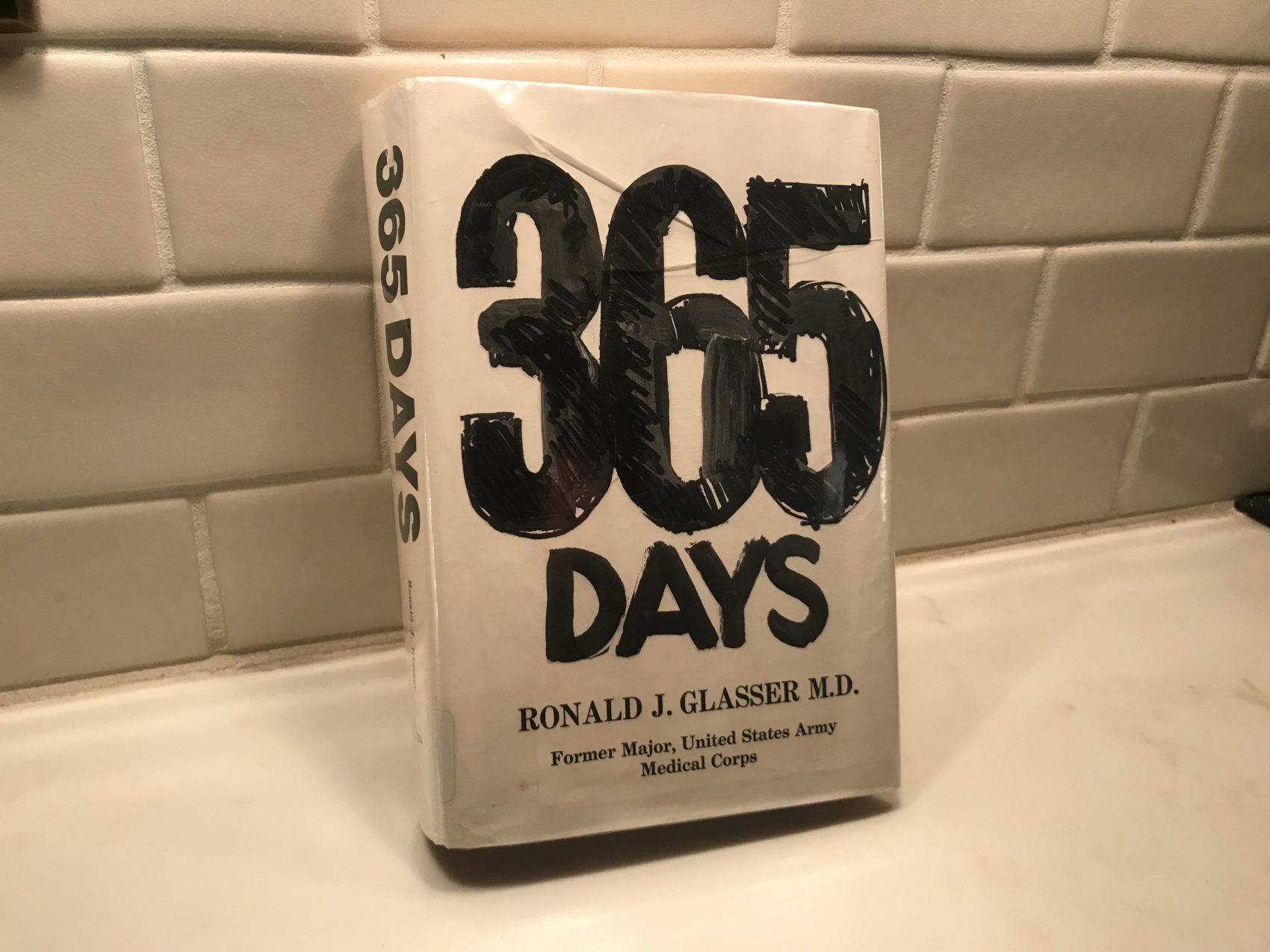
Ronald J. Glasser died on August 26th. He was a pediatric nephrologist in Minneapolis, but his medical career began in earnest in September 1968, when he was assigned to an evac hospital in Zama, Japan. They treated wounded soldiers choppered in from Vietnam. Ron chronicled his Zama experience, and even more so the experience of his patients, in his book “365 Days.” It was a finalist for a National Book Award, and is considered one of the most authoritative books on the combat experience of soldiers in Vietnam.
I was lucky to run into Ron at work. It seems ridiculous to me, even now, that he liked my writing, and that he gave me the names and numbers of people to talk to. He gave me a hand up, and his friendship. Thank you Ron.
His wife, Joy, asked me to be one of the speakers at his funeral. I played my best for him, pa rum pum pum pum.
“Hey Ron! It’s Craig Bowron, your favorite hospitalist. Sorry to be here, but happy to be talking and thinking about you.
Ron recognized the term “favorite hospitalist” as a jibe and an oxymoron. He didn’t like hospitalists, for all the right reasons. We were there to serve the health care machine, to make things work more efficiently, faster; to allow primary care clinic doctors to work more efficiently, faster. Hospitalists were degrading the ancient patient-physician relationship, replacing the familiar with the anonymous, and Ron didn’t like it. Not one bit.
Thankfully our relationship did not suffer for my being a hospitalist, and in fact, it came to be because I am a hospitalist. I work at Abbott Northwestern Hospital, which is physically and in a small way medically connected to Children’s Hospital, where Ron worked. Ron would often wander over to the doctor’s lounge at Abbott. You could find him sitting in a chair, coffee in one hand, a rolled up medical journal or article he had printed off in his other hand.
Our docs lounge meetings were never orchestrated, just random. When I’d walk through the door and we’d lay eyes on each other, Ron would call out my name. “Craig.” Not in a “Cheers” kind of “Norrrrrrmmmmmmmm!” way. More like “Craig, get over here.” Sometimes he said what he usually only inflected: “Craig, we need to talk.”
He’d begin by asking me what I was working on, what I was writing about. That was our bond: writing about medicine. I got used to the routine: Ron would listen diligently, sincerely, earnestly about my latest piece, and then as soon as I was done, he’d call me to something higher, something far more serious and consequential. “Craig, you need to write something about…”
His list of grievances that needed to be publicly addressed was long. The shenanigans of Big Pharma. The obscene profits of health care companies liked United Health. The consolidation of health care into a small number of multi-billion-dollar corporations. The electronic medical record demoting patients to a secondary issue. Ron was not just a writer, he was a crusader. I was flattered that he would even consider me capable of joining these battles, but I knew I couldn’t write quite like he did. That wasn’t my gig. He was secret service. I was a mall cop.
One thing that made Ron’s list of “Egregious wrong’s to be righted” was the crippling and often unrecognized or at least unappreciated effects of this terrible new weapon: the improvised explosive device, the IED, the roadside bomb.
I was entering elementary school when Ron was serving in Zama Japan, but by the time the wars in Iraq and Afghanistan were being waged, we were colleagues and friends. What Ron witnessed first-hand in Zama, and what we witnessed together in Iraq and Afghanistan, was the grammatical absurdity of war being tallied as the number of killed or wounded. “Killed” is a very definitive word. “Wounded” is not. It’s very ambiguous, sometimes intentionally so.
As Ron pointed out in several books, body armor and rapid high-level trauma care was saving lives in Iraq and Afghanistan, keeping soldiers out of the killed category, and putting them into the wounded category.
But the wounds caused by IEDs were ghastly. A nineteen-year-old soldier with no legs was something much more than wounded. Something much more than “non-ambulatory.” A 26-year-old had had more than just his “bell rung.” Something more than a concussion. Something more than a traumatic brain injury. Forget about “wounded”: How about “Permanently altered,” “Forever changed.”? How about “Shattered”?
Be it an RPG in Viet Nam or an IED in Iraq, Ron the physician, Ron the writer, wanted all of us to know and to understand what these wars were really costing us, what we were asking some of these soldiers to sacrifice. So Ron went to war with war. He was a war correspondent, the best of his kind. The brilliance and power of his “365 Days” is that he was able to write so beautifully and so elegantly about something so unredeemably ugly as war.
I’ll let Ron speak for himself. From “365 Days”
“But I had been sent to Japan as a pediatrician to serve the children of the dependent military population there. I soon realized that the troopers they were pulling off those med evac choppers were only children themselves.”
“At first, when it was all new, I was glad I didn’t know them; I was relieved they were your children, not mine. After a while, I changed. These kids were so brave, they endured so much, they were so uncomplaining that you couldn’t help but feel proud of them. I can remember only one boy who would not stop screaming.”
“I did not start writing for months, and even then it was only to tell what I was seeing and being told, maybe to give something to these kids that was all theirs without doctrine or polemics, something they could use to explain what they might not be able to explain themselves. It was a brutal time for them, …”
“If there is more to say it will have to be said by others, though I wonder how they will do it. There is no novel in Nam, there is not enough for a plot, nor is there really any character development. If you survive 365 days without getting killed or wounded you simply go home and take up again where you left off.”
“As for me, my wish is not that I had never been in the Army, but that this book could have never been written.” R.J.G.



I first read Ron’s book “The Body is the Hero” wbich was on the “new and notable” table at the Claremont NH library; I was a newly registered pharmacist (1974 URI) and working at a local pharmacy. I found his writing style unique and not unlike my own…explaining very complex processes of the immune system in simple, logical and easily understandable language. I probably bought and recommended The Body is the Hero to at least 25 of my colleagues and patients over the years
Anyway, it tooks 45 years and the internet age to reach out to Joy via his website and learned that he was already in a dementia care facility. She had to read my email to him…
I lost a few of my friends in Vietnam so 365 days hit home in a personal way. Ongoing conflicts throughout the world go on and on and on..as does the human carnage, both physical and mental. Will we ever learn?
I’m also a brain tumor survivor still struggling with both physical limitations from the surgery and the “normal” aging process. My mobility is limited to drive-thru establishments, and I can only drive with a left-foot accelerator adapter. My wife of 20 years is caring for her Dad and his wife who are both 93 and struggling.
I recall waking up in Sunrise Hospital (Las Vegas), and a resident standing over me telling me I had a brain tumor. My first words..”Why me?” His reply…”Why not?”
I also wrote a book about weight loss based on my own 20 year struggle. I went from 265 to 170ish at age 21. Never found a publisher (talk about a tought business) but still live by it. I liked your tribute to Ron and I’m open to further reading on any subject you want. Thanks.
Hi Brian. I am sorry for your troubles, but I am glad to hear you’re in the survivor category. I don’t know how you took the explanation “Why not?,” and though I get it and understand it’s philosophical tone, I am not sure it’s what one needs to hear when waking up from anesthesia. I lean more towards empathy. We can parse out the rest of it later, when you’re feeling better.
Wow, that’s a dramatic weight loss, but I am glad you found a way back to the real you. I think the health field is a difficult place to publish. Everyone wants to be healthy, but the fact is, they’d prefer to read a thrilling piece of fiction.
So much good stuff to read out there. I really enjoyed RJG’s “Another War, Another Peace” and “Ward 402.” Barbara Kingsolver’s “Demon Copperhead” is a beautiful tome (and worthy of her Pulitzer Prize) and I am halfway into Verghese’s “The Covenant of Water,” which is scrumptious and wise.
Thanks for the note Brian!